Dental lab protocols
Your lab protocol stops being a PDF.
Tell us how you work: which services you offer, which records each one needs, and in what order. The TrazaLab team programs it into your account, and every case is created following your protocol.
For labs and dentists · Enterprise plan
From your sheet to your account
What you write is what gets asked for.
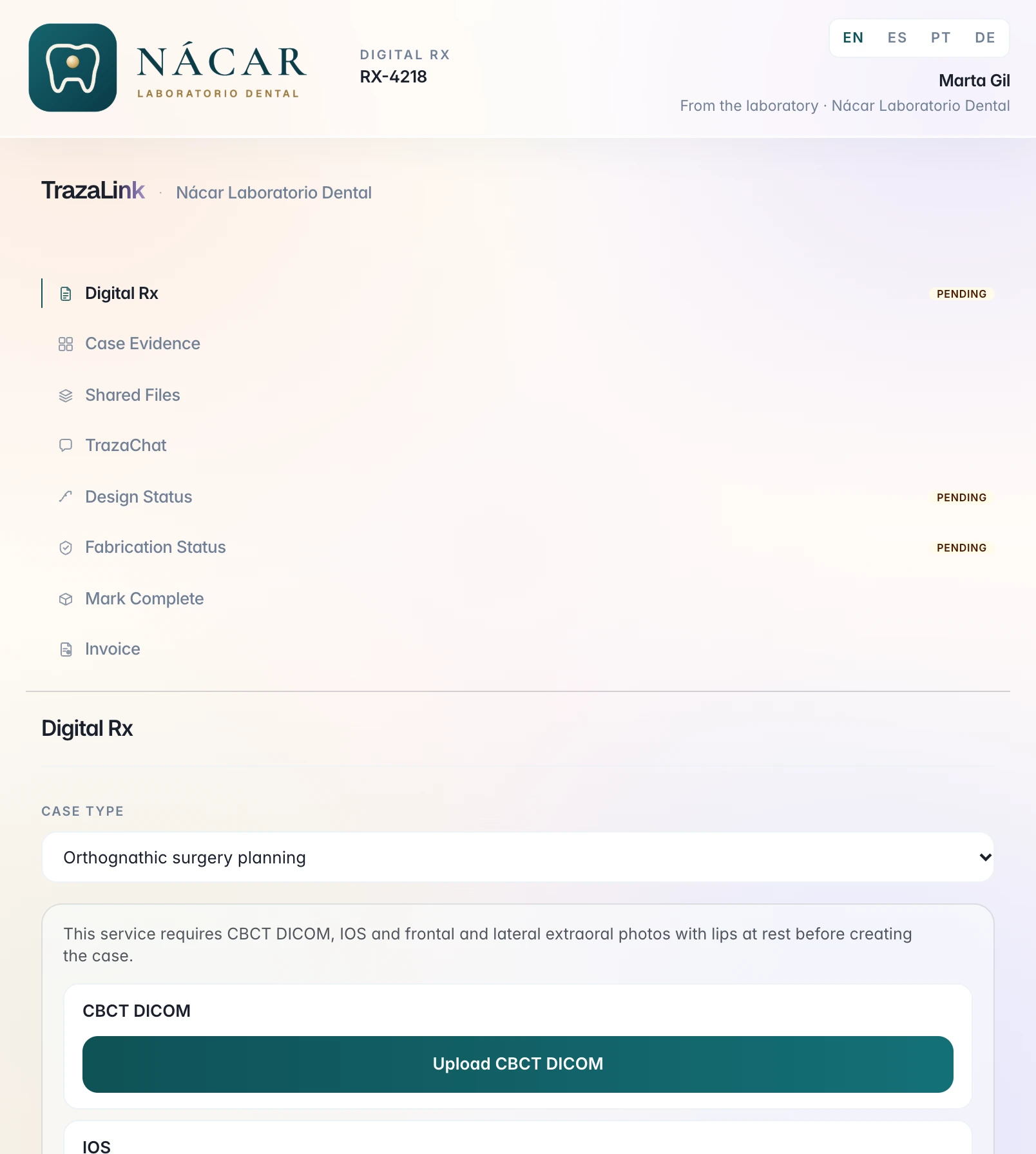
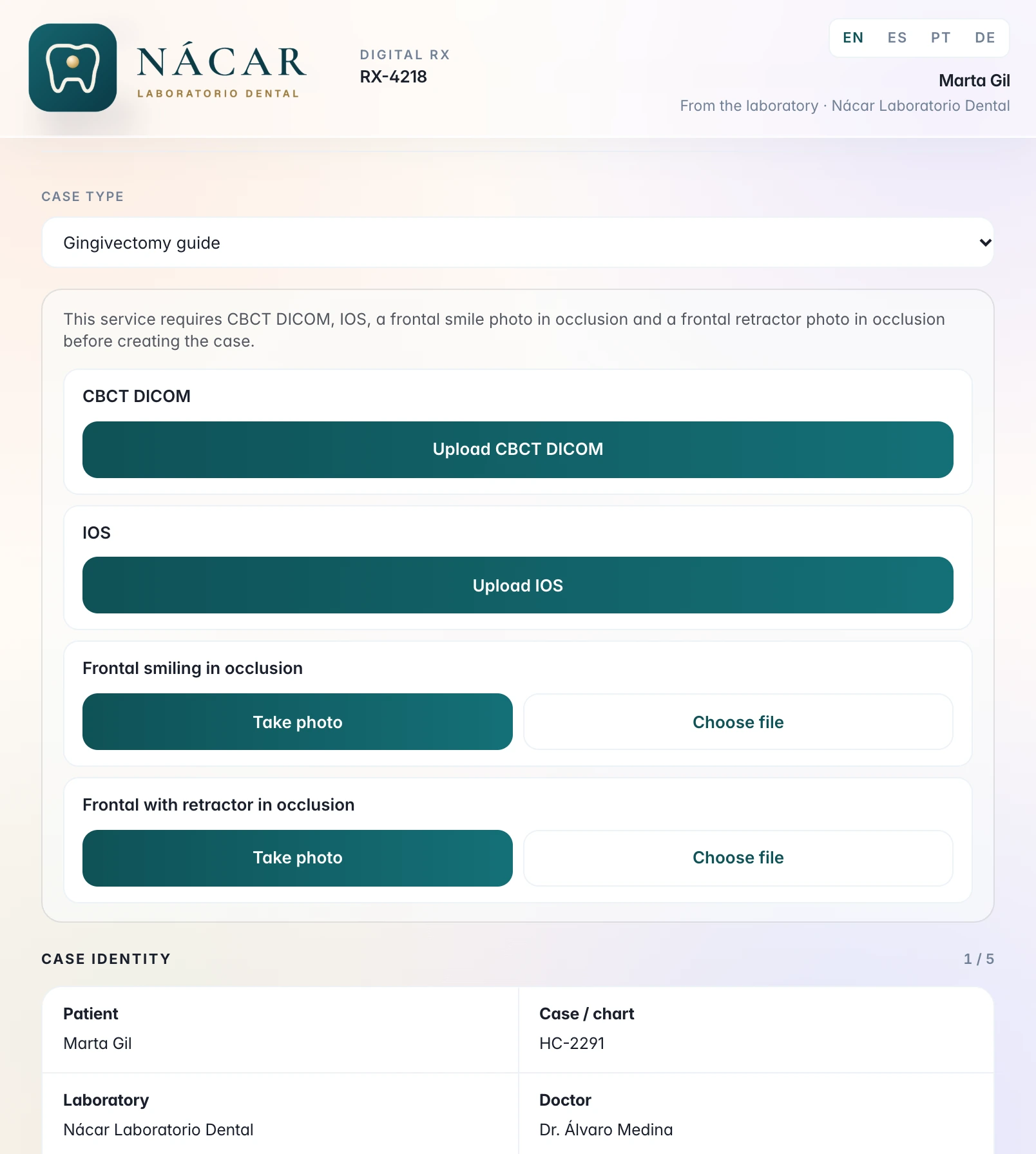
Each line of your protocol becomes a service with its own slots. The dentist picks it in your lab's TrazaLink.
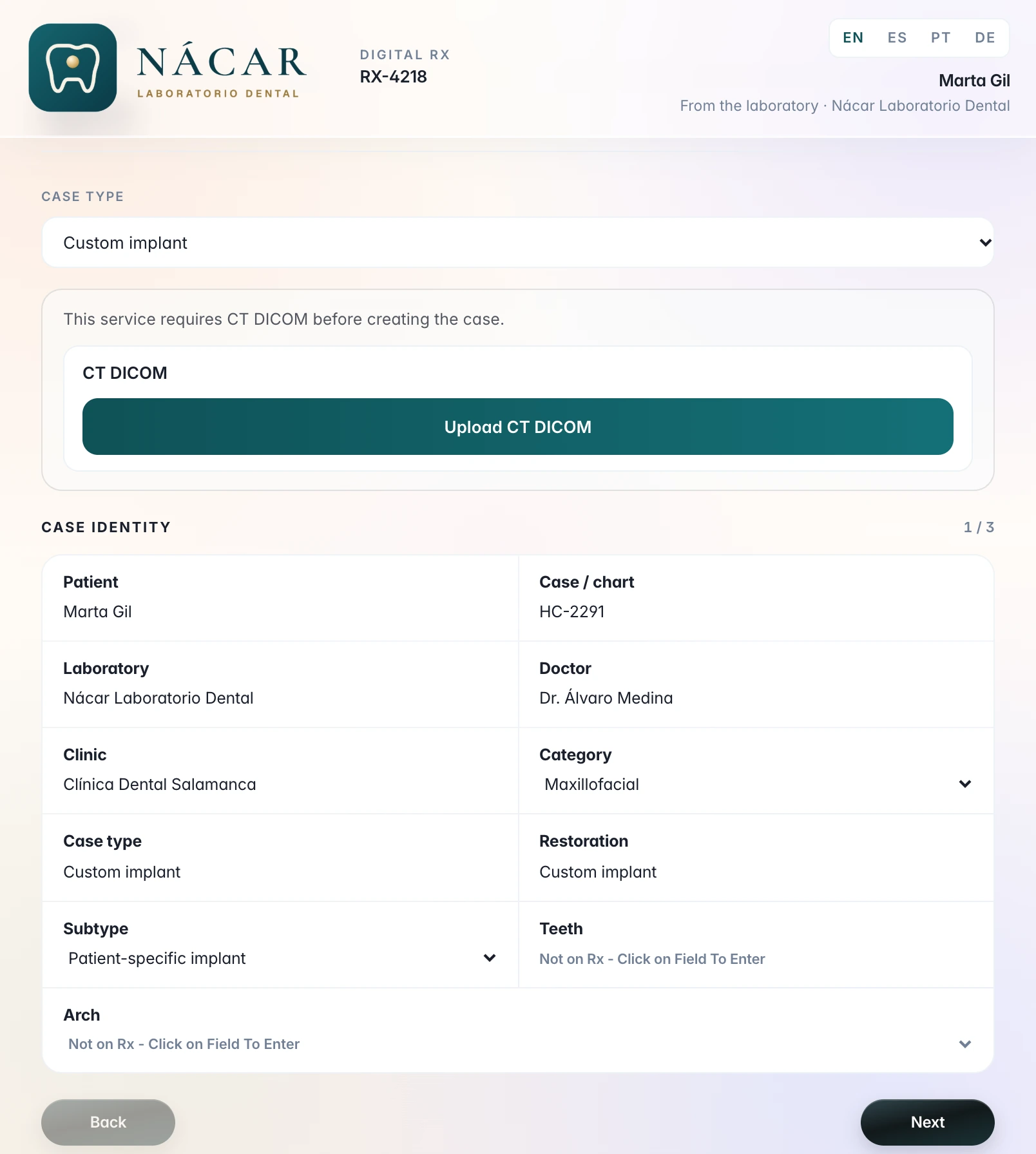
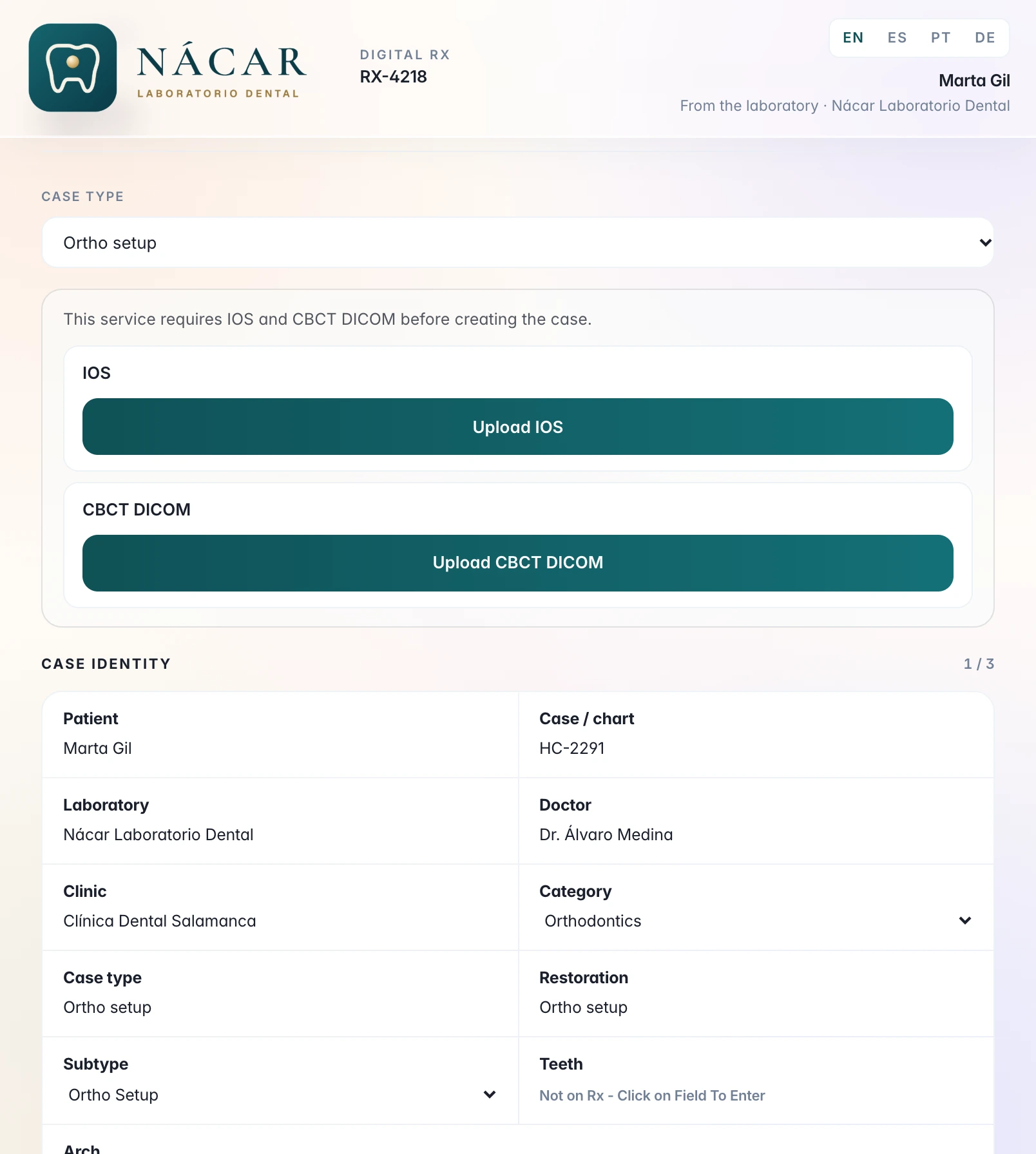
When the case is created
No last record, no order.
Each slot takes its own files: the CBCT, DICOM or ZIP; the scan, STL, PLY, OBJ, or 3MF. The check also runs on the server, not just on screen.
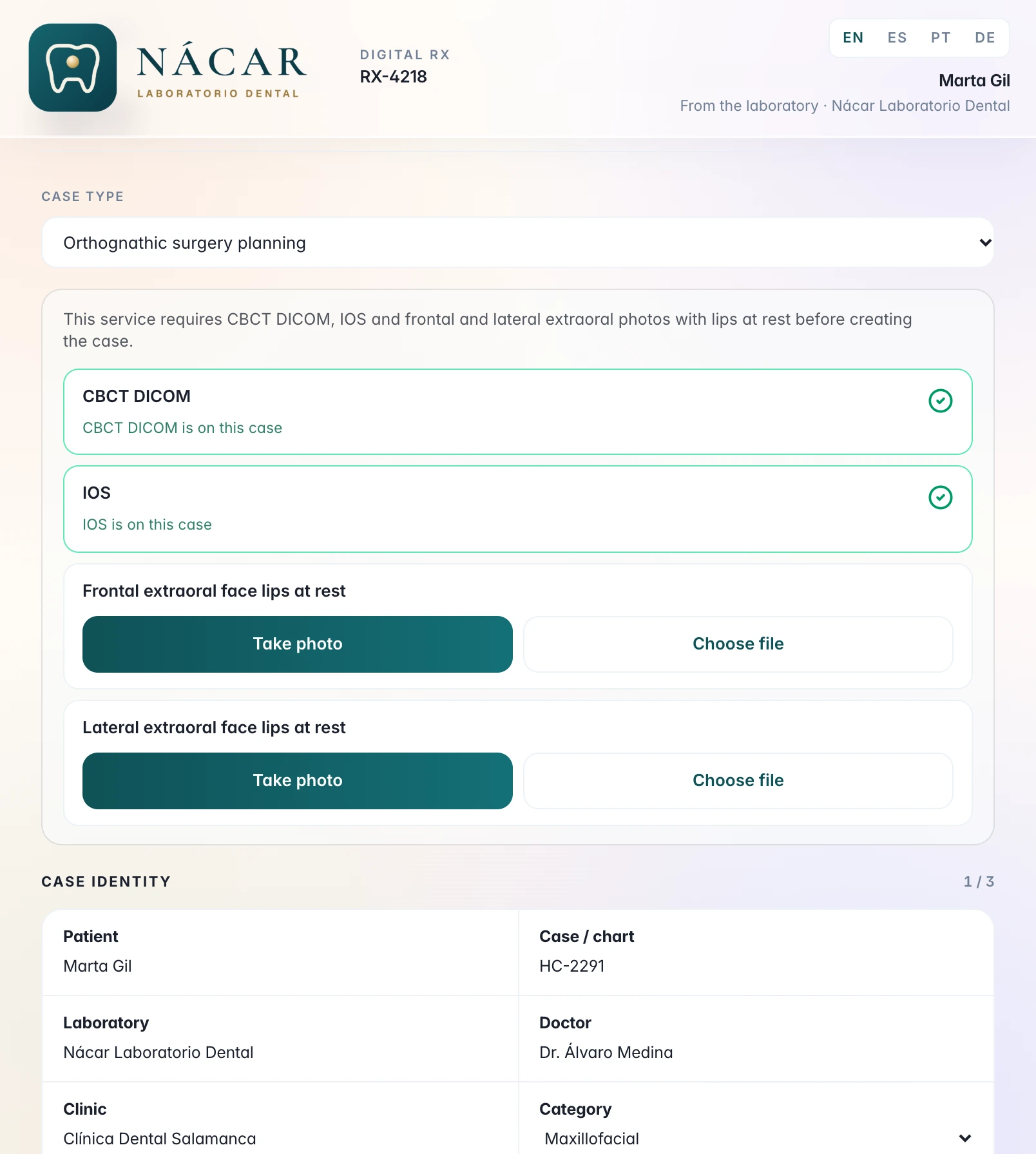
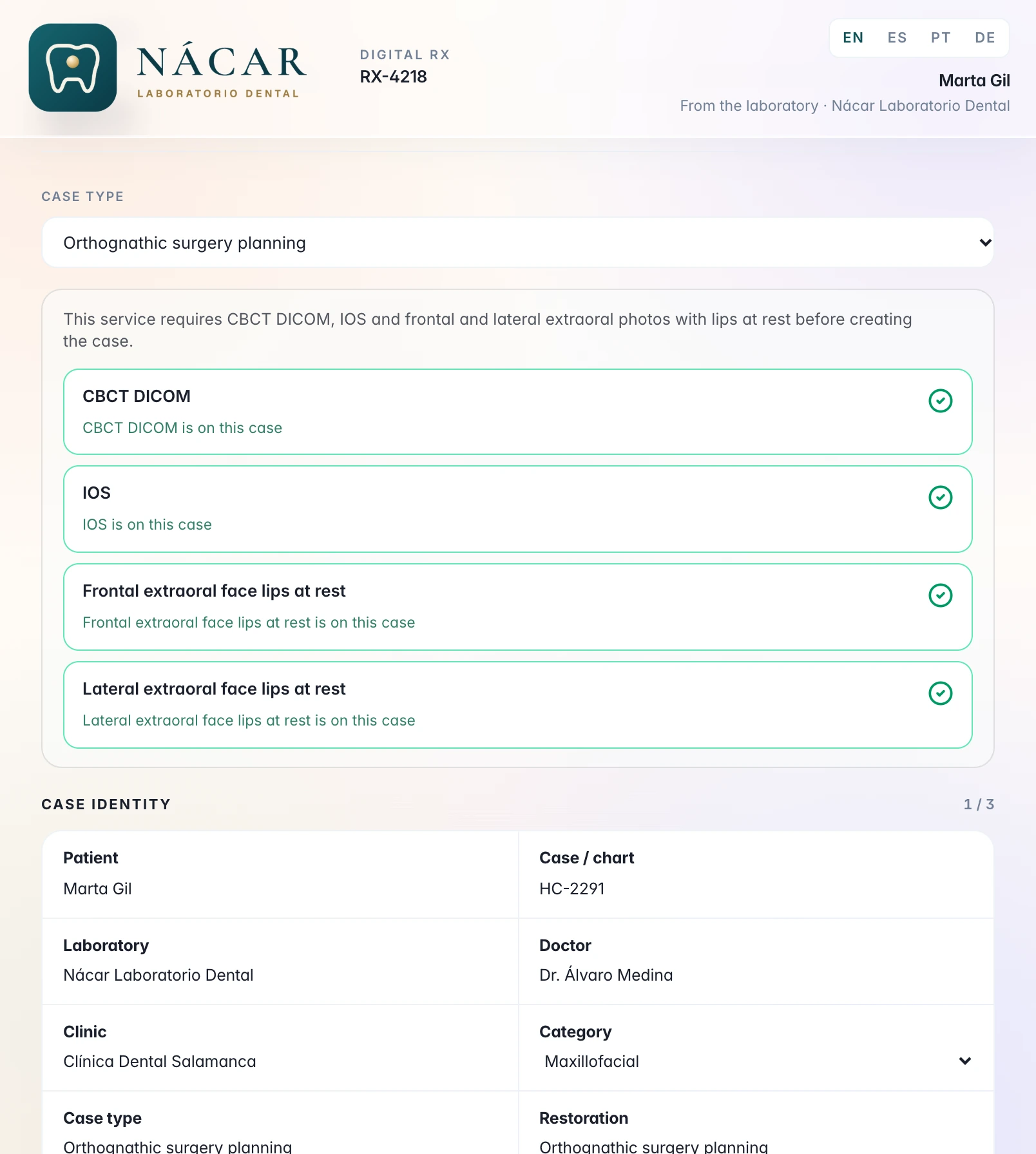
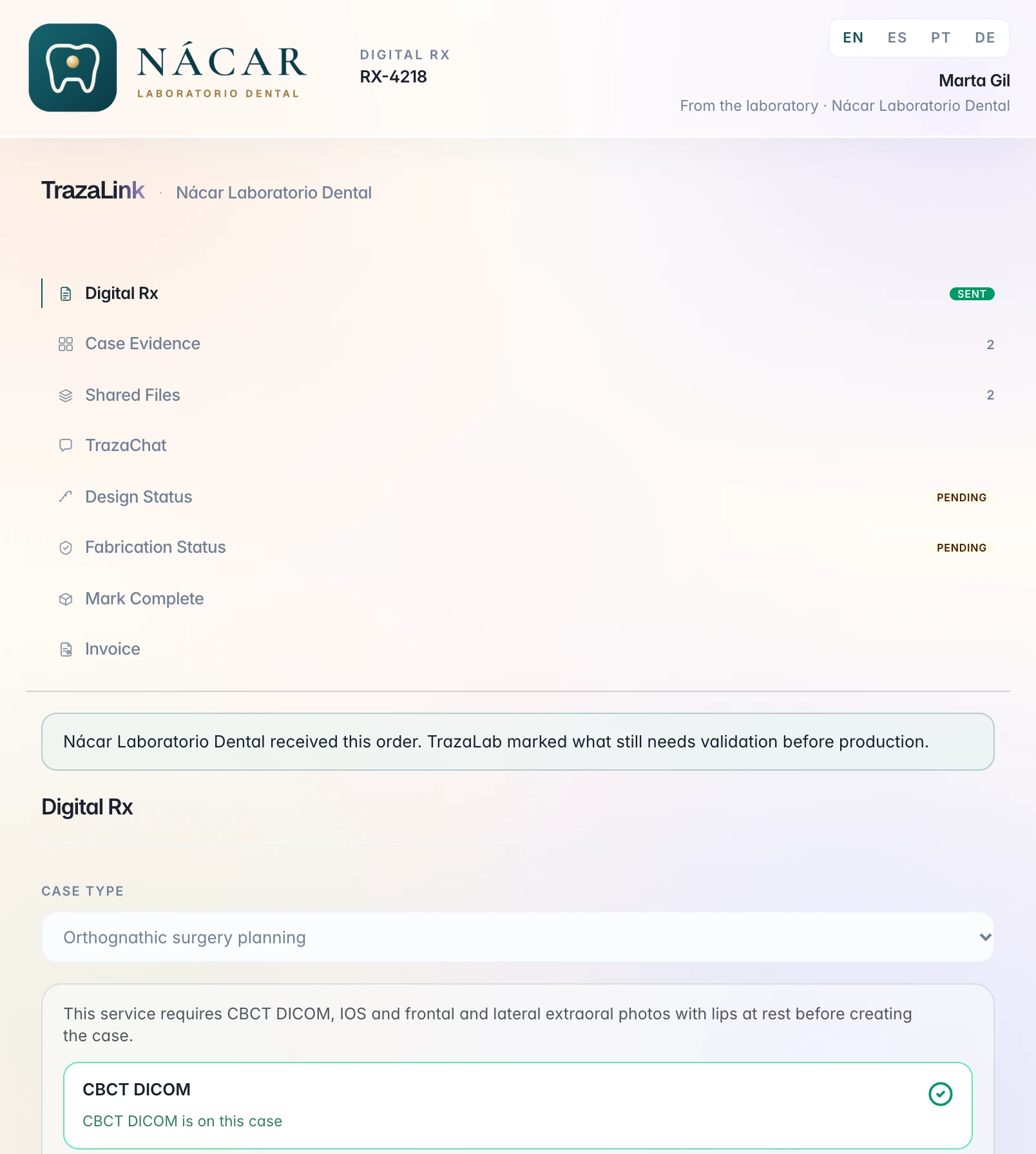
When the case arrives
Complete on arrival. Starts when you say.
Production doesn't move until you change it.
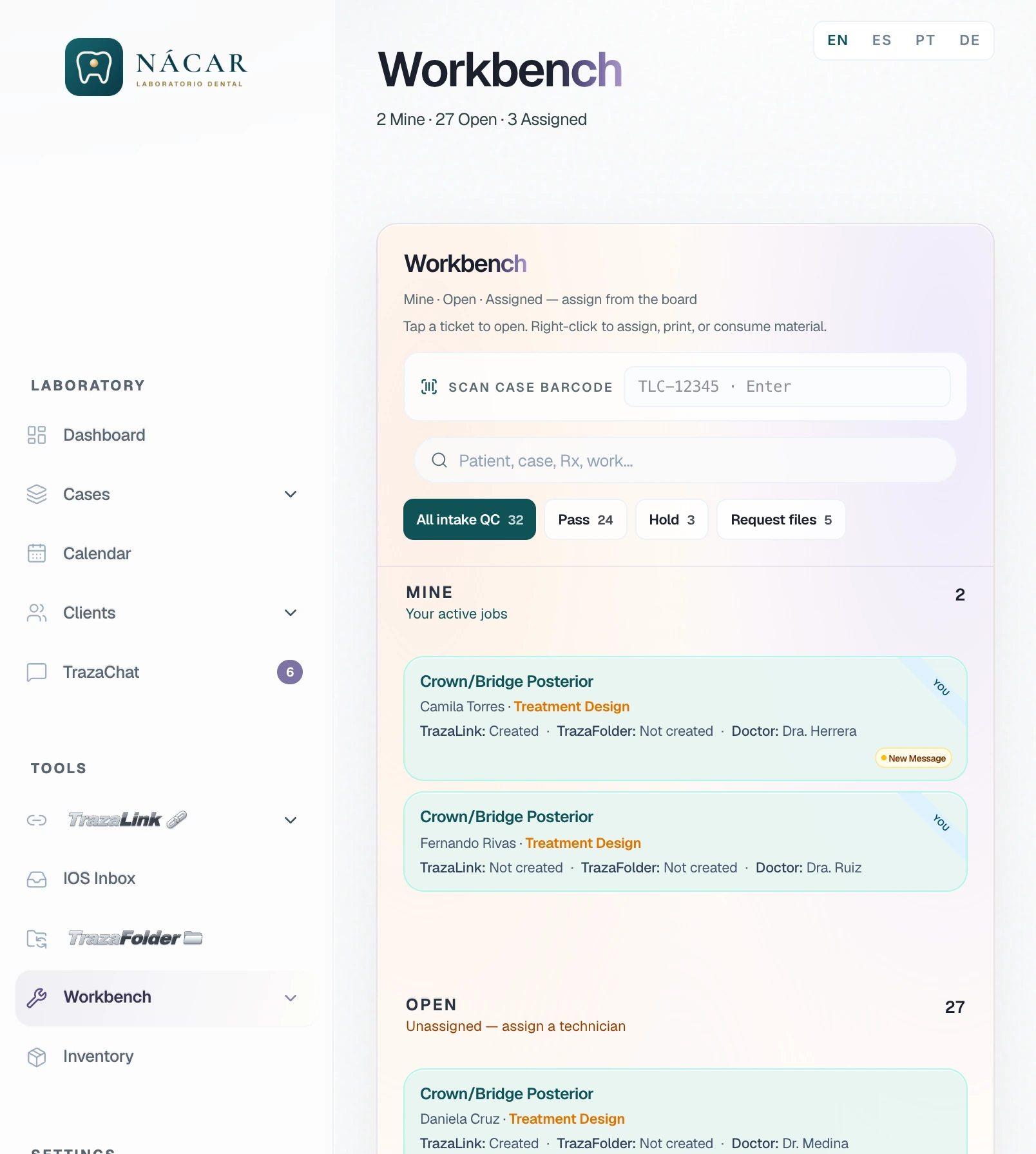
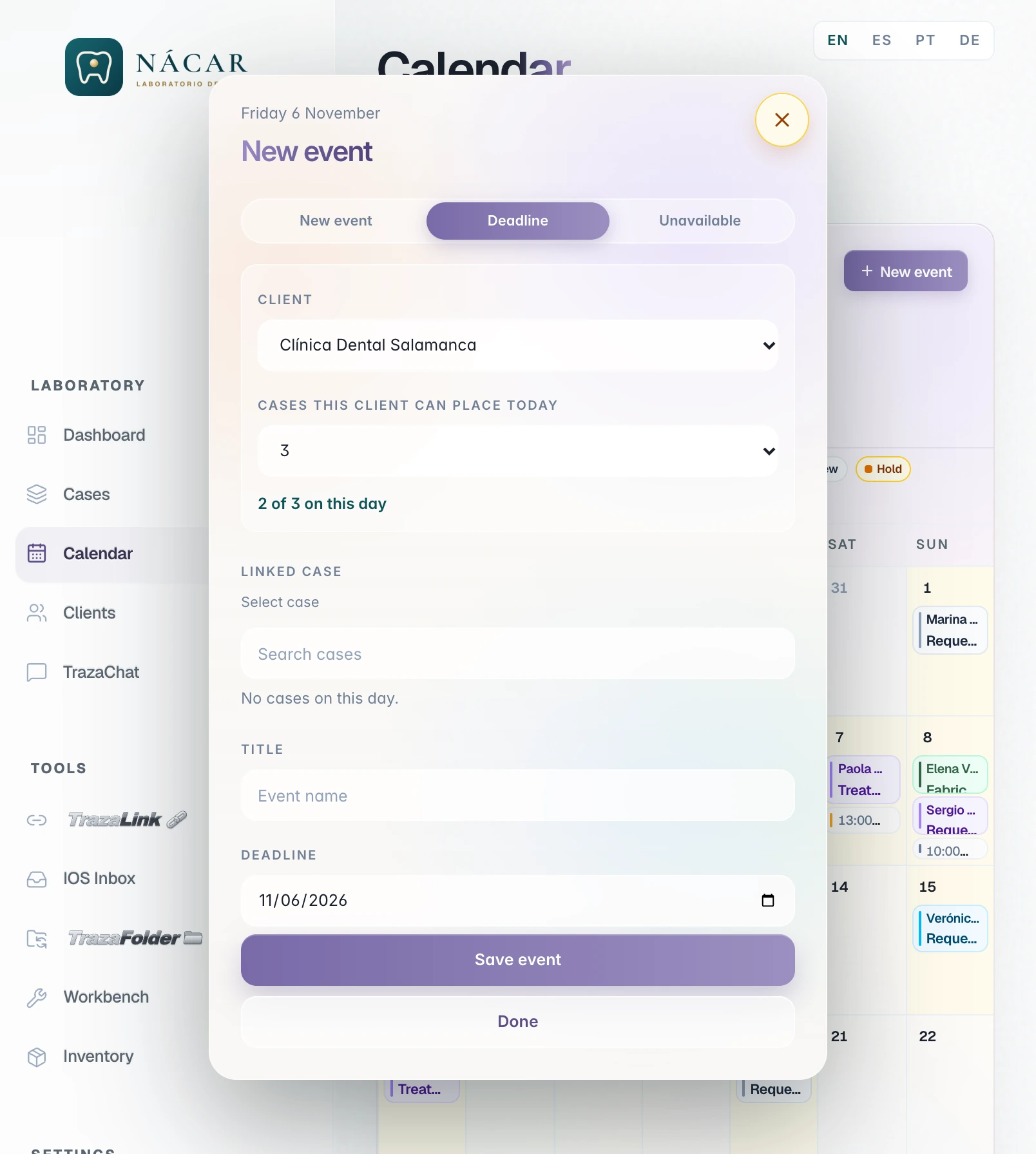
What a protocol is
How a case has to arrive.
Not your biosafety protocol or a clinical one. It's the one your lab defines, service by service.
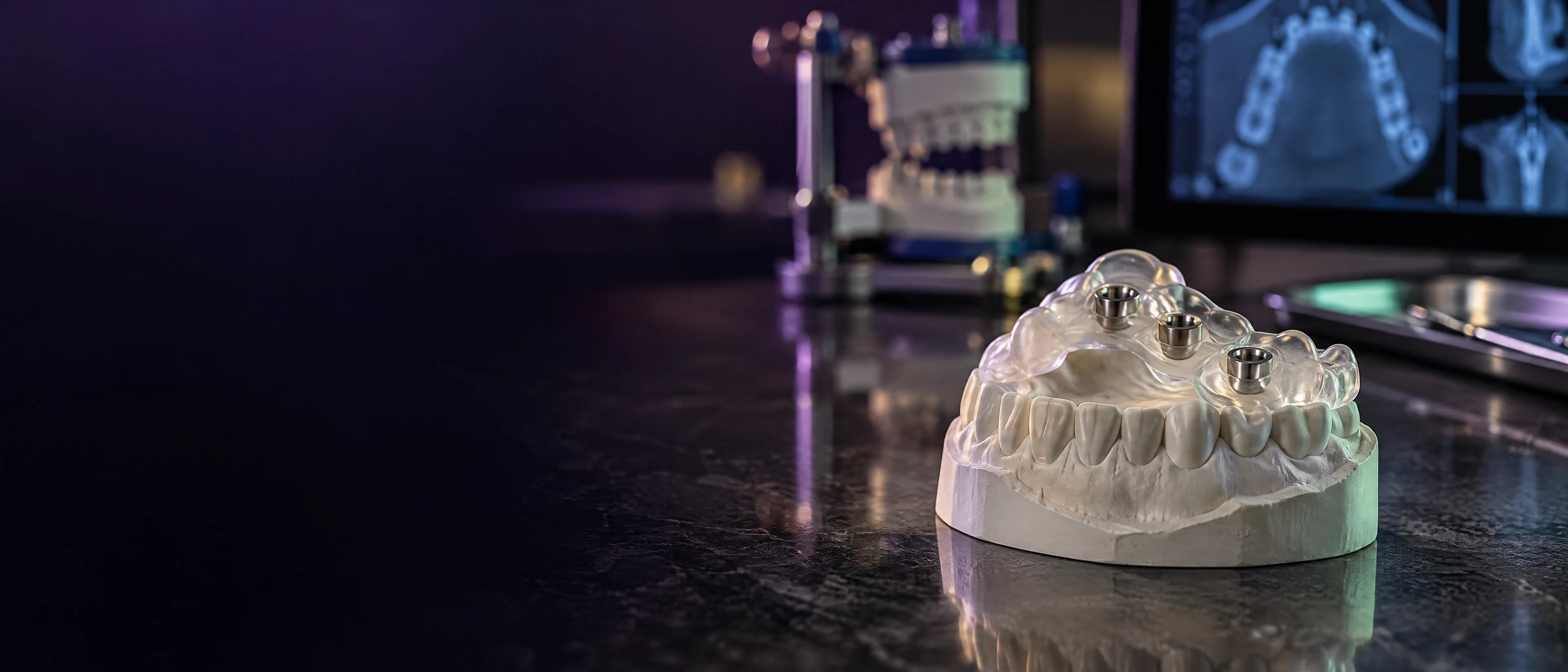
A tooth-supported guide needs a DICOM CBCT and an intraoral scan, with the arches separated with cotton rolls. CBCT first, then the scan. If one is missing, the case doesn't send.
- ServiceWhat you design or make, under the name you use.
- RecordsWhat each service needs: CBCT, scan, photos, bite.
- ConditionsHow each record must arrive: slice thickness, photo angle.
- OrderWhat gets filled in first and what comes next.
- What's missingWhat happens to the case when not everything arrives.
There is no standard
Six teeth. Or four. Or three.
That's the minimum three published protocols ask for with the same tooth-supported guide. It's why a generic form can't carry yours.
- Dual scan
- Radiopaque markers on the denture: 4 to 6 in one protocol, 5 to 7 in another.
- Custom TMJ
- CT slice thickness: 1 mm maximum in one, 0.5 to 1.25 mm in another.
- Scanning position
- Mouth closed in one; in occlusion or with the arches slightly separated in another.
What each service asks for
Ten services, and what they usually need.
Examples from protocols published by labs and manufacturers. Yours may ask for something else, and that's what we program.
Crown or bridge
Records
Scan or impression of the preps, opposing arch, bite, and shade.
Conditions
Bite with a single thin line of material.
Veneers
Records
All margins, full opposing arch, bite, and shade.
Conditions
Without a bite, the lab estimates occlusion. Stump shade and photos recommended.
Implant crown
Records
Scan body scan, with system, platform, and diameter on the prescription.
Conditions
Scan body fully seated and captured whole. Removed before the bite scan.
Tooth-supported guide
Records
Multi-slice DICOM CBCT, STL or impression of both arches, and bite.
Conditions
Arches separated with cotton rolls. A CBCT in occlusion holds the case.
Full-arch guide
Records
Dual scan: the patient wearing the denture, and the denture alone, with radiopaque markers.
Conditions
Denture with no metal or soft reline. Markers don't move between scans.
Gingivectomy guide
Records
Photos, intraoral scan, CBCT, and smile design.
Conditions
We found no public protocol; these records come from published cases.
Setup and indirect bonding
Records
Full-arch scans and occlusal registration; bracket system, prescription, and slot.
Conditions
The clinician approves the setup before fabrication.
Clear aligners
Records
Intraoral scan and photos.
Conditions
No holes or double surfaces, and 3 to 5 mm of gingiva, or it's rejected.
Complete denture
Records
By route: edentulous, with a reference denture, or immediate. With photos.
Conditions
The reference denture is scanned on foam or cotton, never on a hard radiopaque surface.
Custom maxillofacial
Records
CT or CBCT in DICOM, uncompressed.
Conditions
A scan with motion artifact isn't used. Maximum age of 4 months in one protocol.
How you hand it over
You send it. We program it.
There's no editor in Settings: the TrazaLab team does it.
- You send it.Your services, what each one needs, and in what order. In Excel, in PDF, or however you already have it.
- We program it.The TrazaLab team sets it up in your account, exactly as you asked.
- You review it.You try it out before you start using it.
- You start.From then on, every case follows your protocol.
- If it changes, tell us.A new service, another photo, another record: we update it. Included in Enterprise.
Lab
For your clinics.
We program what each service asks of your dentists, and they find it in your lab's TrazaLink.
Lab EnterpriseDentist
For your lab.
Send us the sequence your lab asks for, and we set it up in your account.
Clinic EnterprisePrescription
A protocol isn't a prescription.
The protocol says what the lab needs. The prescription is signed by the professional and is the basis of the custom-made device.
- European Union
- A custom-made device is made to the prescription of an authorized person, for one specific patient (Regulation 2017/745, Art. 2.3).
- Spain
- A dental prosthesis prescription states the device's characteristics and the dentist's details: name, address, college number, date, and signature (RD 1594/1994, Art. 1).
- Records
- The custom-made device statement is kept for at least 10 years, or 15 if implantable (Regulation 2017/745, Annex XIII).
- Other countries
- Rules differ. Check the ones where you practice.
Questions
Questions about protocols.
The rules a lab uses to accept a case: which services it offers, which records each one needs, what condition they must arrive in, in what order, and what happens if something is missing. It is not a clinical or biosafety protocol.
What a protocol isA rule is one specific thing a case must include before it can be created. The protocol is the whole set: your services, your records, your conditions, and their order.
Case creation rulesSend us your services, what each one needs, and in what order, in Excel, in PDF, or however you already have it. There is no editor in Settings: the TrazaLab team programs it into your account.
How you hand it overStart with the service you receive most: what you need to make it and in what order. You can walk us through it in the demo.
How you hand it overWhile a slot is empty, the case can't be sent. The dentist sees which record is missing and uploads it in its slot.
The orderThe case with its records, on your board. On the Workbench, cases are sorted into Pass, Hold, and Request files, and production doesn't move until you change it.
When the case arrivesYes, with Clinic Enterprise. Send us the sequence your lab asks for and we set it up in your account.
Lab and dentistTell us and we update it: a new service, another photo, another record. It's included in Enterprise.
How you hand it overIt depends on how many services your protocol has. We'll give you a timeframe once we've seen it.
How you hand it overLab Enterprise for labs and Clinic Enterprise for dentists and clinics.
PricingNo. The protocol sets out what the lab needs. The prescription belongs to the authorized professional, with their details and signature.
PrescriptionNo study we reviewed measures that directly. What is documented comes separately: in an audit in Dundee, 28% of fixed prosthesis prescriptions were satisfactorily completed, rising to 43% after staff training; across seven labs in Riyadh, 6.5% of 40,344 restorations were remade.
SourcesRegulation (EU) 2017/745 · RD 1594/1994 · Dickie et al., 2014 · Alkadi et al., 2026 · National Dentex, surgical guide · National Dentex, Keller · Straumann · Arrowhead · ROE, dual scan · ROE, records · ROE, zirconia · ROE, veneers · ROE, digital denture · Glidewell, implants · AAO, indirect bonding · Aligner rejection guide · Crown lengthening, published case · Stryker, TMJ · KLS Martin, TMJ