
Re-tightening, as the manufacturer states it
Megagen states no re-tightening interval in the AnyRidge, Blue Diamond or AnyOne External catalogues we read.
IMPLANT TORQUE · MEGAGEN
One implant site. Five moments where a number decides whether the screw holds: placement, healing, abutment, prosthesis, re-tightening. Every value below is quoted from Megagen documentation, with the document named beside it.
Scale 0–70 Ncm. Select a component to move the pointer. Values beyond the scale sit at its end.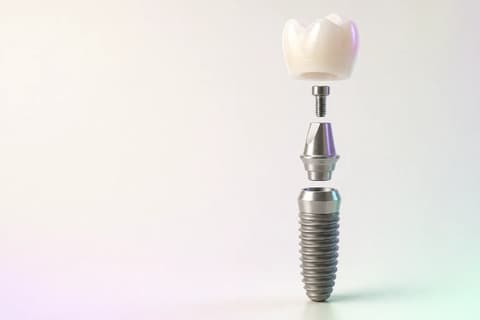 EDITORIAL VISUALIZATION
“Place implant fixtures according to the surgical plan and do not exceed torque value (60 Ncm).” “If an implant engine (40 Ncm) stops leaving one millimeter above the crest, use ratchet wrench.”
THE VALUES
Rows are grouped in treatment order. Where Megagen publishes a hand-tight instruction instead of a number, the row says so. Where nothing is published, the row says that too.
| Component | Applies to | Torque | From the document | Source |
|---|---|---|---|---|
| PlacementInsertion torque of the fixture | AnyRidge — engine stops at 40, ratchet to the surgical plan, never above 60 Driver: Implant engine (40 Ncm) · ratchet wrench | ≤ 60Ncm | “Place implant fixtures according to the surgical plan and do not exceed torque value (60 Ncm).” “If an implant engine (40 Ncm) stops leaving one millimeter above the crest, use ratchet wrench.” | MegaGen AnyRidge catalogue (imegagen, 2019 upload, R2)Manufacturer document |
| PlacementInsertion torque of the fixture | Blue Diamond — 45 recommended, maximum 80 Driver: Ratchet wrench | 45Ncm | “45 Ncm placement torque is recommended. If higher placement torque must be delivered due to the bone quality, it should not exceed a maximum of 80 Ncm.” “Excessive placement torque may cause deformation of the connection.” | MegaGen BLUEDIAMOND Implant EN rev. 04Manufacturer document |
| HealingHealing abutment · cover screw | Cover screw · healing abutment — by hand Driver: 1.2 hex hand driver | 5–8Ncm | “Recommend torque: by hand (5–8 Ncm)”, printed for the cover screw and the healing abutment in both the AnyRidge and Blue Diamond documents. | MegaGen AnyRidge catalogue (imegagen, 2019 upload, R2)Manufacturer document |
| AbutmentFinal abutment screw at implant level | AnyRidge abutment screw M1.8 / M2.0 (two-piece abutments) — general guidance 25–35 Driver: 1.2 hex driver (max 30 Ncm on the hand driver) | 25Ncm | “25–35 Ncm is recommended to connect a permanent abutment into a fixture.” Per component: “Abutment Screw (M1.8 & M2.0): 25 Ncm.” The hand driver itself “should use under 30 Ncm torque … Excessive torque more than 30 Ncm may cause fracturing of the driver.” | MegaGen AnyRidge catalogue (imegagen, 2019 upload, R2)Manufacturer document |
| AbutmentFinal abutment screw at implant level | One-piece abutments — Straight, Octa, Solid, EZ Post, Gold, Milling, Angled Driver: Abutment driver · ratchet | 35Ncm | “Straight Abutment (M1.8 & M2.0): 35 Ncm”; “Octa Abutment … Recommend torque: 35 Ncm”; “Solid Abutment … Recommend torque: 35 Ncm.” | MegaGen AnyRidge catalogue (imegagen, 2019 upload, R2)Manufacturer document |
| Multi-unitMulti-unit abutment into the implant | Multi-unit Abutment [AR] → implant: straight 35 · 17° and 30° angled 25 Driver: MUA driver / right-angle driver (straight) · 1.2 hex (angled) | 35 · 25Ncm | “Multi-unit Abutment [AR] — Straight … Recommend torque: 35 Ncm”; “Multi-unit Angled Abutment [AR] — 17° … 30° … Recommend torque: 25 Ncm. For 17° abutment, you need to tighten it by tilting Driver about 5°.” | MegaGen AnyRidge catalogue (imegagen, 2019 upload, R2)Manufacturer document |
| Prosthetic screwScrew that holds the prosthesis on the abutment | Cylinder screw M1.4 on Multi-unit Driver: 1.2 hex driver | 15Ncm | “Cylinder Screw (M1.4): 15 Ncm.” “Set denture onto Multi-unit Abutment and tighten cylinder — Cylinder Screw tightening torque: 15 Ncm.” | MegaGen AnyRidge catalogue (imegagen, 2019 upload, R2)Manufacturer document |
| TemporaryTemporary abutment or coping | Temporary Abutment (titanium) · Temporary Cylinder — EZ Post cylinder 35 Driver: 1.2 hex driver | 25Ncm | “Temporary Abutment (Titanium) … Recommended torque: 25 Ncm”; “Temporary Cylinder — Cylinder Screw (IRCS200) included. Recommend torque: 25 Ncm.” | MegaGen AnyRidge catalogue (imegagen, 2019 upload, R2)Manufacturer document |
Megagen states no re-tightening interval in the AnyRidge, Blue Diamond or AnyOne External catalogues we read.
Newest revision read: 2019. Manufacturers revise these documents; the revision printed on your IFU wins.
Values are quoted from manufacturer documentation and can change by component, platform and revision. Confirm the IFU for the component and lot in your hand before torquing.
WHY THE SCREW LOOSENS
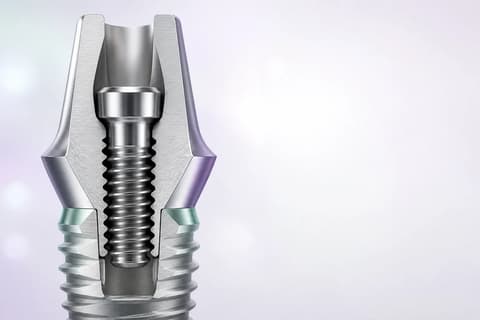
Torque creates preload — the clamping force that keeps abutment and implant pressed together. Microscopic peaks on the thread surfaces flatten under that load, and part of the preload is gone before the patient leaves the chair. The literature calls it the settling effect, or embedment relaxation.
Preload
ONE SITE, FIVE MOMENTS
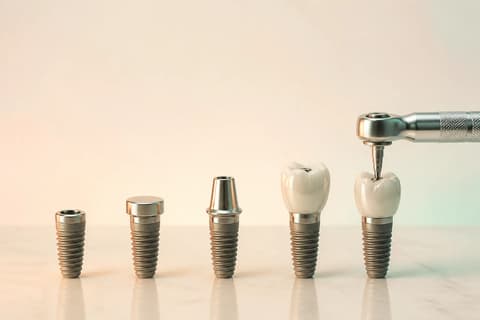
Site 36, one fixture, one crown. The same Megagen values from the table, placed on the moment each one is read off the wrench.
 EDITORIAL VISUALIZATION
AnyRidge — engine stops at 40, ratchet to the surgical plan, never above 60
Cover screw · healing abutment — by hand
AnyRidge abutment screw M1.8 / M2.0 (two-piece abutments) — general guidance 25–35
Cylinder screw M1.4 on Multi-unit
AnyRidge abutment screw M1.8 / M2.0 (two-piece abutments) — general guidance 25–35
Shown as the same value as the abutment row. Whether and when to re-tighten follows the manufacturer statement quoted in the values section.
AFTER THE CLICK
In TrazaLab the implant line on a tooth site keeps system, platform, connection, abutment and applied torque together. It travels into the Digital Rx and onto the laboratory’s per-tooth sheet. An unconfirmed torque is not blank — the laboratory sees it as a gap.
See the Digital RxOTHER SYSTEMS
Each page is built the same way: quoted values, the document beside them, and the gaps stated as gaps.
Final abutment · Conical Connection (CC) · Tri-channel (NobelReplace) · External hex (Brånemark)
Final abutment · CrossFit (BL/BLT) · TorcFit (BLX) · TLX NT/RT/WT
Final abutment · Grand Morse (GM) — one prosthetic platform for Helix, Drive, Titamax, Helix Long and Zygoma
Final abutment · Tapered Screw-Vent internal hex (TSV · TM · TSX) · 3i Certain internal · 3i External hex
Final abutment · Conical connection (C1 · V3) · Internal hex (Seven · M4) · Multi-Unit · CONNECT
Final abutment · TS internal conical hex — mini and regular platforms (TS II · TS III · TS IV)
Final abutment · Internal hex (Tapered Internal · Tapered Pro · Tapered Plus · 3.0 · Tissue Level) · Conical (Tapered Pro Conical)
Final abutment · AnyRidge internal conical · Blue Diamond conical · AnyOne External hex
Final abutment · ET / EK internal conical hex — mini and regular platforms · SS (Octa) · EM
QUESTIONS
Values are quoted from manufacturer documentation and can change by component, platform and revision. Confirm the IFU for the component and lot in your hand before torquing.
All three appear, for different parts. The general guidance is 25–35 Ncm for a permanent abutment. Per component the small abutment screw (M1.8 / M2.0) is 25 Ncm, some titanium abutments 30 Ncm, and the one-piece Straight, Octa, Solid and EZ Post abutments 35 Ncm. Read the component line, not the range.
60 Ncm. The AnyRidge catalogue says to place the fixture according to the surgical plan and not exceed 60 Ncm, using the ratchet once the 40 Ncm implant engine stops. Blue Diamond is a different implant: 45 Ncm recommended, 80 Ncm maximum, with a warning that excess torque can deform the connection.
No. They are quoted from the manufacturer documents listed on this page, with the revision year noted. The IFU packed with your component and lot is the instruction; this page puts the values next to the treatment step and the case record.
The literature on the settling effect widely advocates a second application at the same value after about ten minutes, and in vitro work shows it partially restores preload. The evidence for a fixed interval is limited. The manufacturer statement for this system is quoted in the values section; where it says nothing, this page does not turn that silence into a rule.
In TrazaLab it is a field on the implant line of the tooth site, next to system, platform, connection and abutment. The Digital Rx carries it to the laboratory, whose per-tooth sheet prints the torque. If it was never confirmed, the packet shows “Not on Rx” instead of a number.
AFTER THE CLICK
TrazaLab records the implant line with its torque on the tooth site, writes it into the Digital Rx, and shows the laboratory exactly what was applied — or exactly what was not confirmed.