
Abutment screw
Clamps the multi-unit abutment into the implant. Tightened once at abutment delivery to the connection-specific value; settles in the first minutes.
IMPLANT TORQUE · MULTI-UNIT ABUTMENT
A multi-unit restoration has two screw joints, and both lose part of their preload in the first minutes after the wrench clicks. This page puts the measured losses, the re-tightening studies and the manufacturer statements side by side — with every figure sourced, and every gap named.
Schematic preload curve, not to scale. Percentages are the ranges reported by the cited in-vitro studies for the component and torque named beside each one.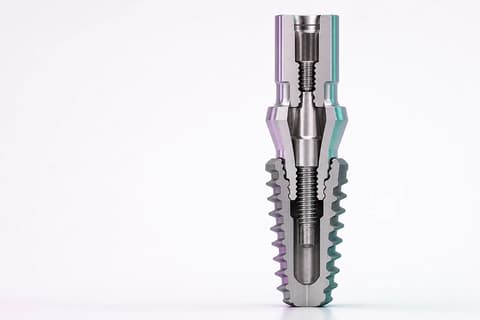 EDITORIAL VISUALIZATION
TWO JOINTS, TWO NUMBERS
The abutment screw clamps the multi-unit abutment into the implant. The prosthetic screw clamps the bridge onto the abutment. They are tightened to different values, they settle independently, and when the lower one is tightened the upper one is affected — a 1995 contact analysis found fastening the prosthetic screw reduced the clamping force at the abutment–implant interface by half. Nobel Biocare publishes both numbers per connection in IFU1075:
Clamps the multi-unit abutment into the implant. Tightened once at abutment delivery to the connection-specific value; settles in the first minutes.
Clamps the bridge onto the multi-unit. Opened and closed at every try-in and every recall — each one a tightening cycle on the same screw.
| Nobel Biocare connection | Straight multi-unit → implant | 17° / 30° multi-unit → implant | Prosthetic screw → multi-unit |
|---|---|---|---|
| Conical connection (CC) | 35Ncm | 15Ncm | 15Ncm |
| Tri-oval conical connection (TCC · N1) | 20Ncm | 20*Ncm | 15Ncm |
| Tri-channel | 35Ncm | 15Ncm | 15Ncm |
| External hex | 35Ncm | 15Ncm | 15Ncm |
Verbatim from IFU1075 Table 1, “Multi-unit Abutment Screw Tightening Torques and compatible screwdrivers”. The asterisk is Nobel Biocare’s. The 45°/60° Zygoma multi-unit on external hex is listed at 35 Ncm. The public Prosthetic Torque Guide shows 15 Ncm for 17°/30° multi-unit abutments and prosthetic screws and 35 Ncm for “all other abutments”, without the TCC exception.
MULTI-UNIT-CLASS VALUES FROM OTHER MANUFACTURERS WE READ
“Abutment (incl. angled abutments) 35 Ncm”; “Occlusal screws 15 Ncm”.
Straumann 702880Straight 32 Ncm, angled 20 Ncm; definitive prosthesis 10 Ncm.
Neodent GM Prosthetics ManualLow Profile abutments 20 Ncm; cylinder retaining screws 10 Ncm.
ZimVie T3 Restorative ManualStraight and angled tapered abutments 30 Ncm. Prosthetic screw value not in the fetched guide.
ZimVie RevitaliZe guideValues are quoted from manufacturer documentation and can change by component, platform and revision. Confirm the IFU for the component and lot in your hand before torquing.
THE TEN-MINUTE QUESTION
The ten-minute rule traces to Siamos 2002 and Winkler 2003. Later studies tested the interval itself. Read left to right: what was tested, what was found, on which component.
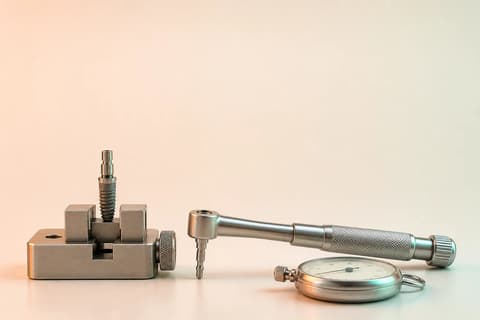 EDITORIAL VISUALIZATION
| Study | Component · torque · design | Finding on the interval | Supports a fixed 10 min? |
|---|---|---|---|
| Siamos 2002Open source | Abutment screws · 25–40 Ncm · in vitro, re-torqued after 10 min | “Retightening abutment screws 10 minutes after the initial torque applications should be routinely performed.” | Supports |
| Kim 2011Open source | Abutment screws · 30 Ncm · 5 connections, settling measured by assembly length | Recommends tightening at least twice at a 10-minute interval; settling plateaus after the second tightening. | Supports |
| Handa 2023 (thesis)Open source | Nobel straight multi-unit · prosthetic screw 15 Ncm · 9 protocols (MSc thesis) | Re-tightening after 10 minutes gave the highest removal torque (12.83 Ncm) versus 10.64 Ncm for a single tightening. Removal torque was always below the applied 15 Ncm. | Supports |
| Varvara 2020Open source | Abutment screws · 35 Ncm · re-tightened at 2, 5 or 10 min, two designs | Two minutes gave the lowest preload loss; 11.6 % lost with no re-tightening. Authors call for randomized clinical trials before a standard interval. | Re-tighten yes · interval open |
| Khalili 2019Open source | Abutment screws · 10 min vs 2 weeks vs none · 100 000 cycles | Re-tightening after 10 minutes and after 2 weeks were “equally effective” against a single tightening. | Re-tighten yes · interval open |
| Sun 2024Open source | Abutment screws · 150 implants · re-torque at 10 min vs loosen-and-immediately-re-torque vs once | Loosening and immediately re-torquing matched the 10-minute protocol and beat a single tightening (immediate stability +6.28–21.58 %, long-term +11.77–44.87 %). | Re-tighten yes · interval open |
| Alnasser 2021Open source | Abutment screws · 32 Ncm · 10-min interval vs no interval vs once vs tighten–counter-tighten cycles | No significant difference between a 10-minute interval, no interval, or a single tightening. Three tighten–counter-tighten cycles gave higher values. | Does not support |
| Al-Otaibi 2018Open source | Full-arch abutment screws · 35 Ncm · torque held 0, 10 or 30 s | Holding the torque longer did not raise removal torque (24.44 Ncm immediate vs 23.37 Ncm at 30 s). Holding is not the same as re-tightening. | Does not support |
WHAT THE EVIDENCE SUPPORTS
What the fetched evidence supports: a second tightening leaves more preload than a single one, in vitro, across abutment screws and — in one thesis — the 15 Ncm multi-unit prosthetic screw. What it does not establish: that the interval must be ten minutes. No randomized clinical trial of a re-torque interval was found.
WHAT THE MANUFACTURERS STATE
We searched the fetched Nobel Biocare, Straumann, Neodent and ZimVie documents for “preload”, “settling”, “re-torque” and any timed re-tightening. The single re-tightening sentence found is conditional. The ten-minute protocol belongs to the literature, not to any IFU.
“Caution — Each time a component is connected to the straight Multi-unit Abutment, make sure the clinical screw is not loosened and is re-tightened if necessary.”Verbatim (English)The only re-tightening sentence in IFU1075. It is conditional (“if necessary”) and sits in the straight multi-unit placement steps, after the caution never to exceed the maximum torque. The words “preload”, “settling” and any minute count do not appear in the IFU, the Prosthetic Torque Guide or the 2011 multi-unit quick guide.
“Make sure the abutments are torqued down with 35 Ncm.”Verbatim (English)Screw-retained abutments 35 Ncm, occlusal screws 15 Ncm. No re-tightening, preload or settling statement in the fetched handling document.
“Place the definitive prostheses, using the Neo Torque Wrench with a torque of 10 N.cm.”Verbatim (English)Mini Conical straight 32 Ncm, angled 20 Ncm, prosthesis 10 Ncm. No re-tightening, preload or settling statement in the Grand Morse prosthetics manual.
“Retighten the abutments to 30 Ncm using the Restorative Torque Wrench [TWR].”Verbatim (English)An impression-step instruction after removing the healing caps, not a settling protocol: no interval, and no “preload” or “settling” anywhere in the two ZimVie guides read.
STRAIGHT VERSUS ANGLED
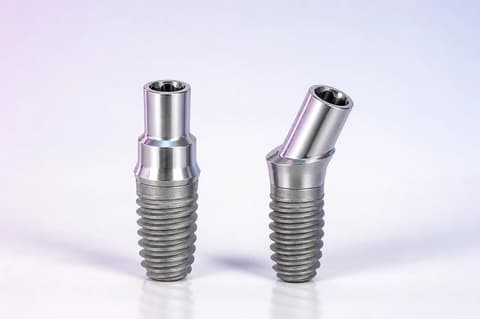
Four recent studies looked at straight versus angled multi-unit abutments. Three in-vitro papers find more loosening with angulation — but not on the same abutment, not at the same torque, and not always the same angle. One clinical series finds no difference.
Torque loss per abutment before cyclic loading; significantly higher on the 30° abutment. Prosthetic screw deformation in 100 % of the 30° group.
Abutment-screw torque loss rose from 11.4 % (both straight) to 19.15 % (both 35°) after aging.
Removal torque after aging fell to 20.1 Ncm on straight and 16.8 Ncm on 17° abutments — the 17° group, not the 30°, was lowest.
No significant difference in torque loss between angled, straight and solid abutments; multi-unit prostheses showed less torque loss than single units.
Not established: a measured preload loss for Nobel Biocare multi-unit abutments at the IFU torques (35 Ncm straight, 15 Ncm angled). The nearest data is the Manitoba thesis on the 15 Ncm prosthetic screw of a straight Nobel multi-unit. This page does not fill that gap with a number.
 EDITORIAL VISUALIZATION
 EDITORIAL VISUALIZATION
SCREW REUSE
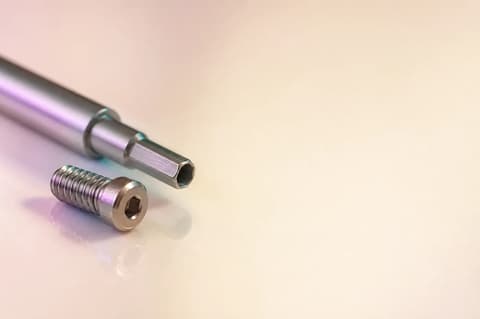
Prosthetic screw at 25 Ncm: after 10 insertion cycles a new screw should be used to maximise reverse torque.
Titanium, gold and gold-coated abutment screws all showed some decay in preload with repeated tightening, irrespective of abutment type and torque.
Across seven systems at 20 Ncm, torque loss grew from 3–20 % on the first opening to 4.5–36 % averaged over thirty cycles.
In multi-unit dentures with misfit, re-torquing the 10 Ncm titanium prosthetic screws made the misfit effect on loosening torque insignificant.
The direction is not uniform across the literature: some studies report removal torque rising with a second or repeated tightening (Kim 2011, Handa 2023), others report progressive loss with many cycles. Screw material, lubrication and connection differ between them.
QUESTIONS
Values are quoted from manufacturer documentation and can change by component, platform and revision. Confirm the IFU for the component and lot in your hand before torquing.
Settling, or embedment relaxation, is the loss of preload that happens after tightening as the microscopically rough thread and seating surfaces flatten under load. The screw shortens slightly and part of the clamping force is gone before any chewing load. Reviews put the early loss at roughly 2–10 % of the initial preload; one study measured 11.6 % at 35 Ncm without re-tightening. A multi-unit restoration has two such joints — abutment-to-implant and prosthesis-to-abutment — and each settles on its own.
In-vitro studies consistently find that a second tightening to the same value leaves more preload than a single one, including one thesis on the 15 Ncm prosthetic screw of a straight Nobel Biocare multi-unit, where re-tightening after ten minutes gave the highest removal torque. The exact interval is not settled: Varvara 2020 found two minutes best, Khalili 2019 found two weeks equal to ten minutes, Sun 2024 found loosening and immediately re-torquing equal to ten minutes, and Alnasser 2021 found no difference at all. No manufacturer on this page states a timed re-torque; Nobel Biocare says to re-tighten the clinical screw “if necessary” each time a component is connected.
No. IFU1075 for Multi-unit Abutments contains one re-tightening sentence, and it is conditional: each time a component is connected to the straight Multi-unit Abutment, make sure the clinical screw is not loosened and re-tighten it if necessary. The words “preload” and “settling” and any minute count do not appear in the IFU, the Prosthetic Torque Guide or the multi-unit quick guide. The ten-minute figure comes from Siamos 2002 and Winkler 2003.
From IFU1075 Table 1: straight Multi-unit Abutment 35 Ncm on conical, tri-channel and external hex connections and 20 Ncm on the tri-oval conical connection; 17° and 30° Multi-unit Abutments 15 Ncm (20 Ncm on tri-oval conical); prosthetic screw 15 Ncm on every connection. Confirm the IFU packed with your component and lot.
Three in-vitro studies report more torque loss with angulation — on a 30° abutment with the 15 Ncm prosthetic screw (Pibulniyom 2026), on 35° Bredent Sky abutments (Al-Zordk 2021) and, unexpectedly, on 17° rather than 30° Nucleoss abutments (Salama 2023). A retrospective clinical study of 308 abutments found no difference between angled, straight and solid abutments (Savabi 2026). The studies use different systems and torques, so the size of the effect is not established.
For the prosthetic screw studied by Guzaitis 2011 at 25 Ncm, a new screw is advised after ten insertion cycles. Byrne 2006 and Weiss 2000 report preload decaying with repeated tightening across screw materials and systems. Every try-in counts as a cycle. Follow the manufacturer’s single-use or reuse statement for the screw in your hand.
REFERENCES
PubMed abstracts were read for every paper; full text where the journal allowed it. Manufacturer PDFs were downloaded and searched. Winkler 2003 and Siamos 2002 were read as abstracts only. Fetched 2026-09-05.
Values are quoted from manufacturer documentation and can change by component, platform and revision. Confirm the IFU for the component and lot in your hand before torquing.
AFTER THE CLICK
TrazaLab records the implant line with its torque on the tooth site, writes it into the Digital Rx, and shows the laboratory exactly what was applied — or exactly what was not confirmed.