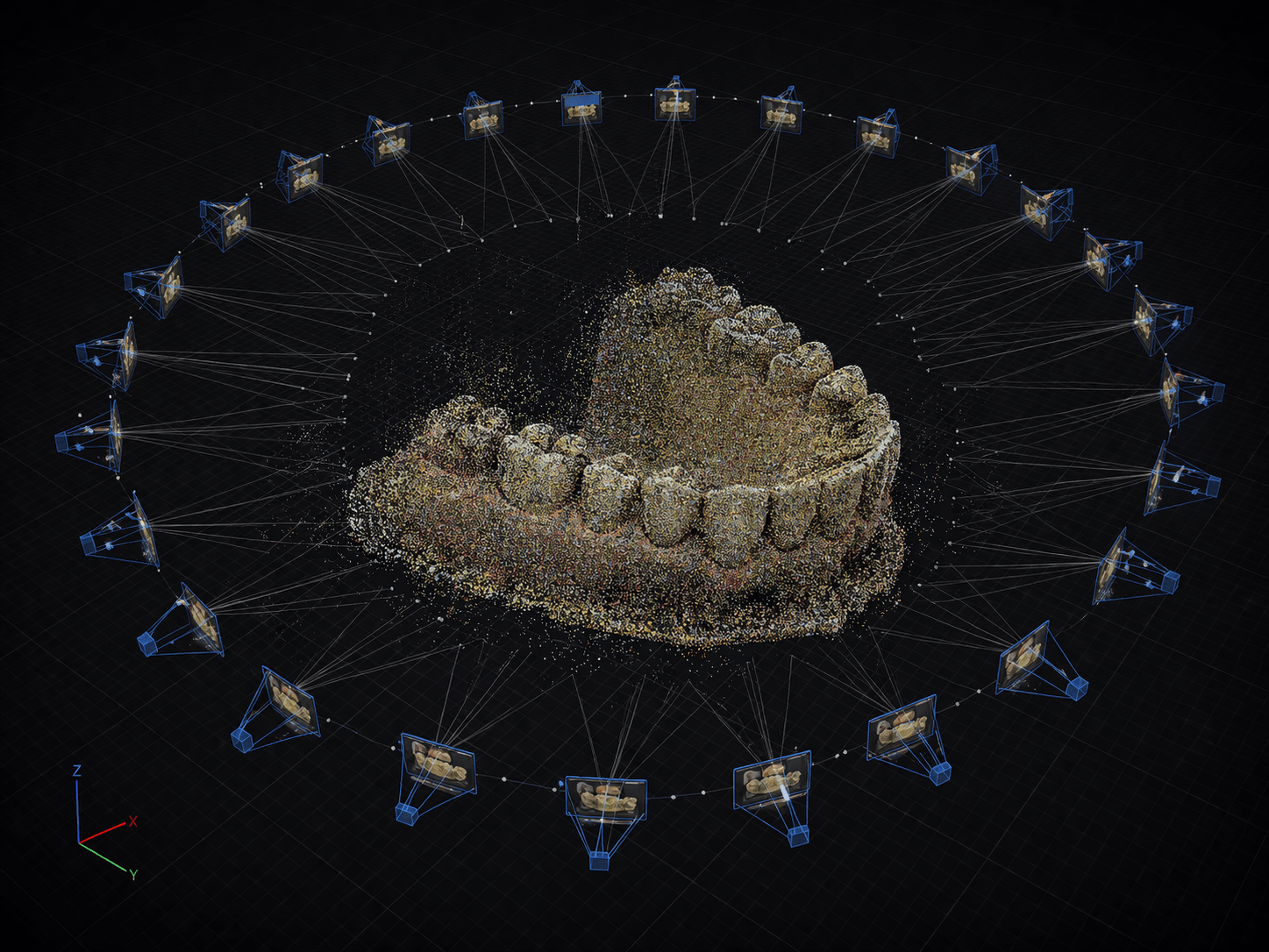
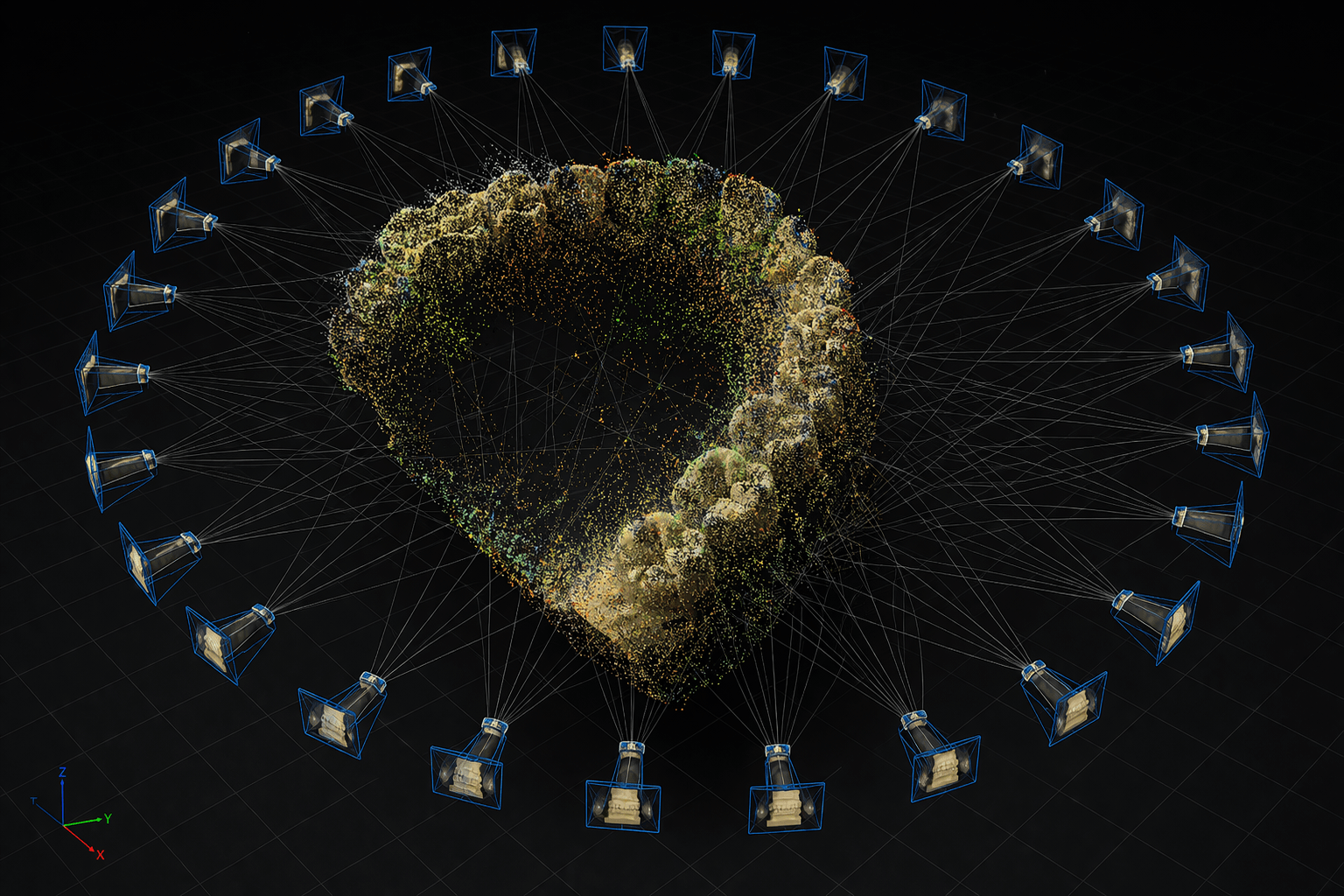
A dental scanner captures thousands of photos and turns them into 3D. Your phone records 4K at 60fps — 3,600 frames per minute. TrazaScan 3D turns those into geometry.
Pick your role. See your full flow — from capture to 3D model.
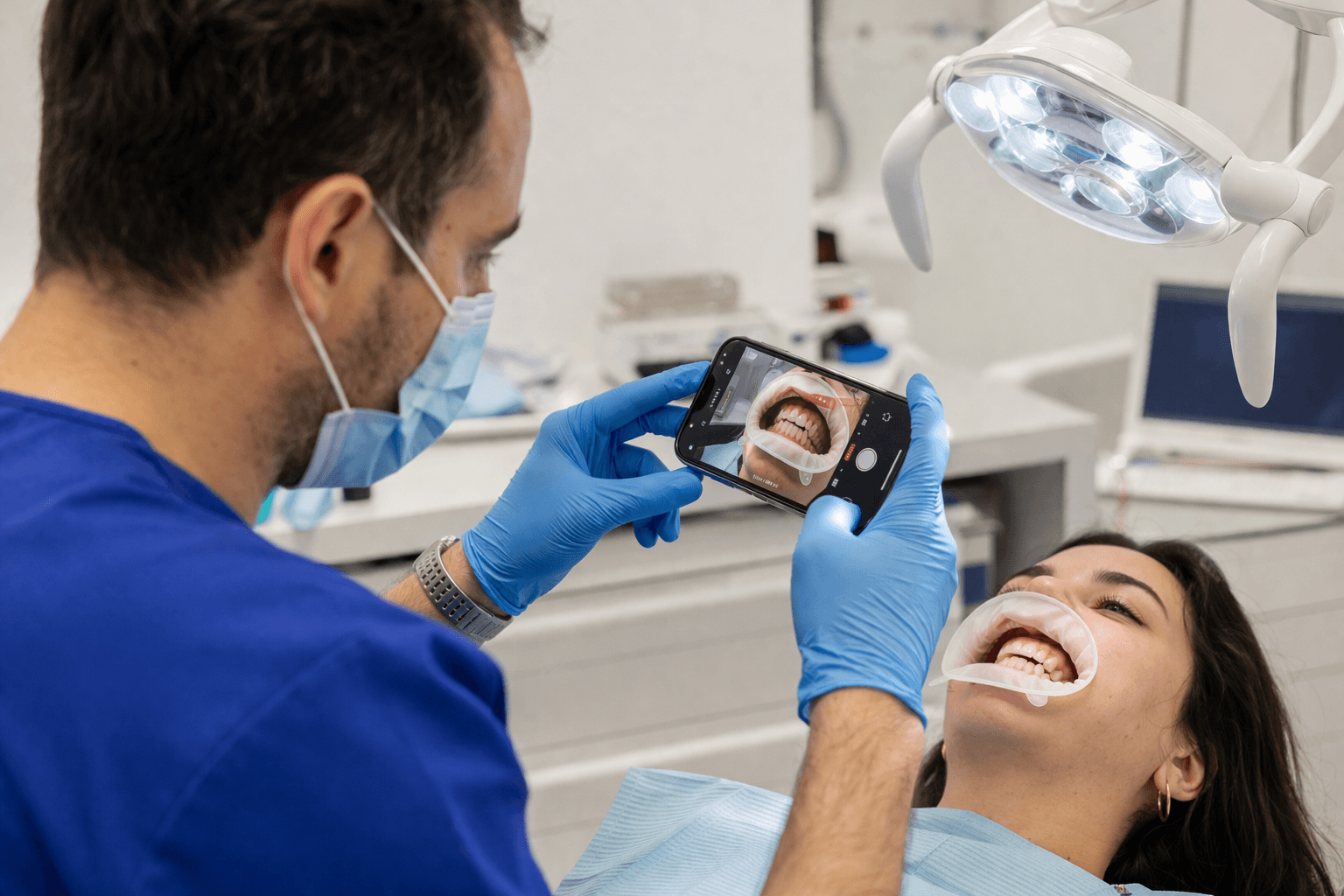
From TrazaScan in your dashboard, turn on the camera and record 60 seconds orbiting the mouth with retractors. The visual guide tells you speed and coverage. When you finish, the video uploads to the platform automatically.
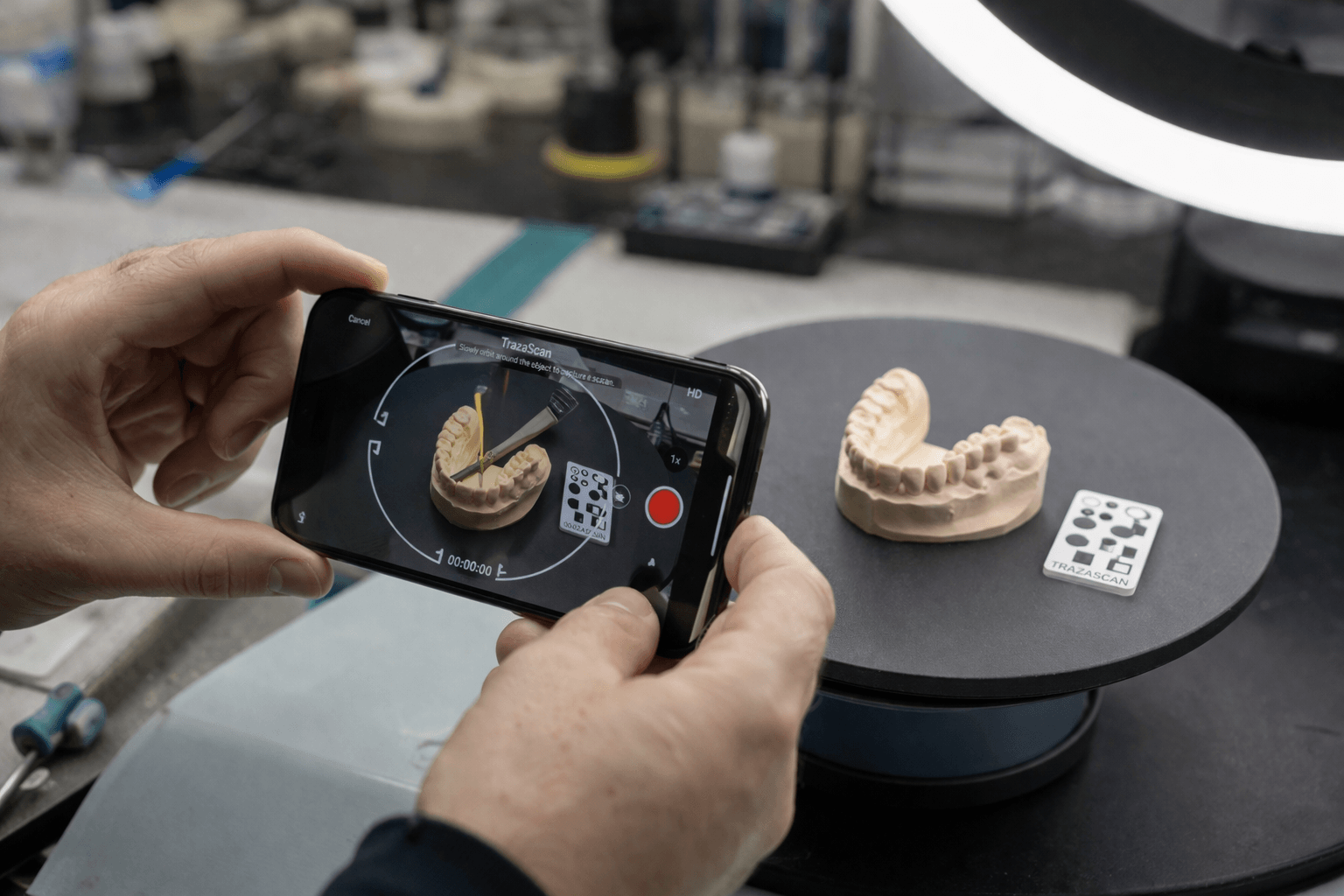
Out of thousands of frames, the system picks the best by sharpness, angular coverage, and consistent exposure. Redundant and blurry ones are dropped. Each frame is a high-resolution photo.
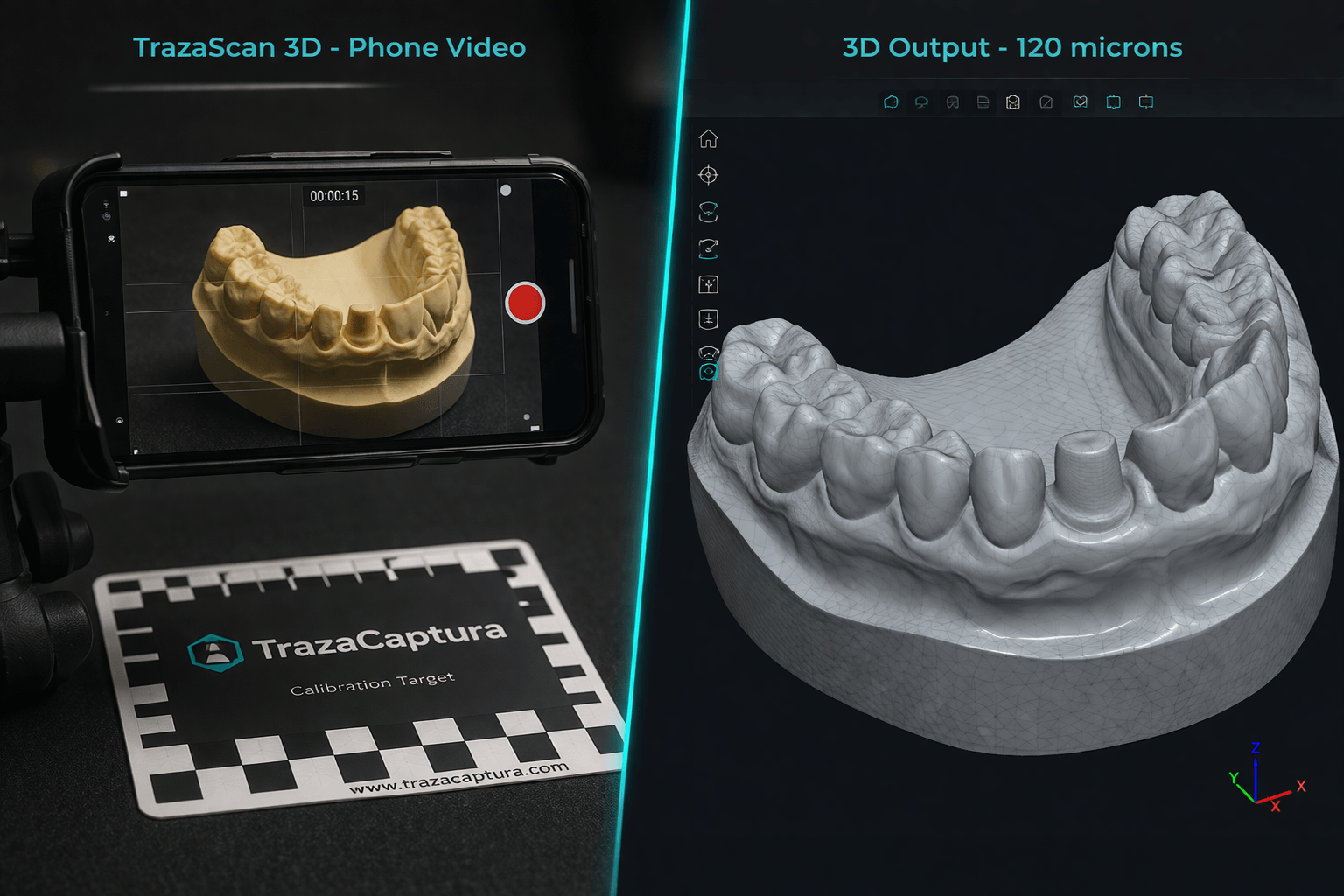
Each frame is analyzed pixel by pixel. SIFT detects edges, cusps, margins. Each point gets a 128-dimension descriptor. They are matched across frames to triangulate 3D positions.
Bundle Adjustment computes the 3D position of each camera. Then Patch-Match generates a dense depth map. Hundreds of thousands of 3D points — dental anatomy in three dimensions.
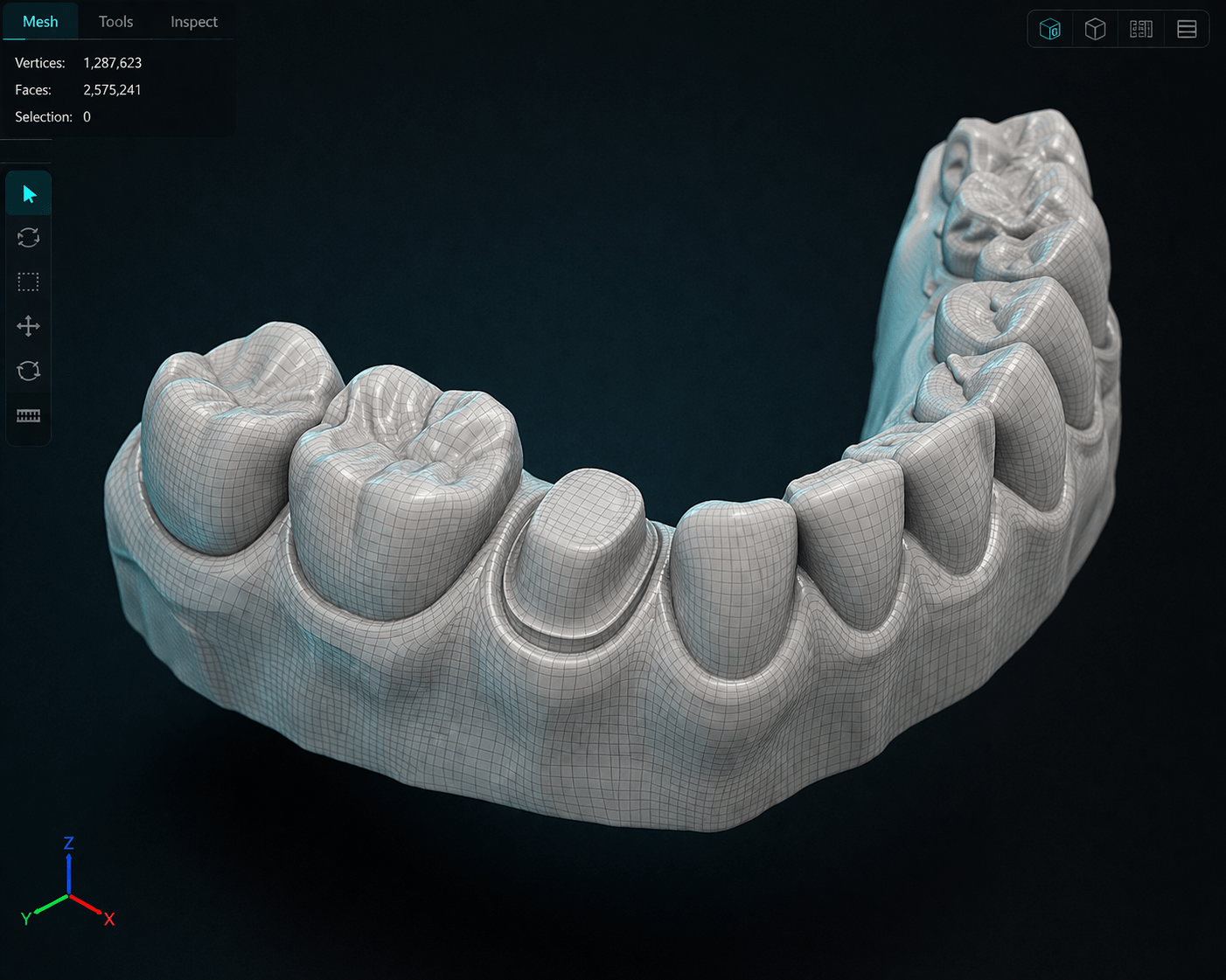
Continuous mesh calibrated to real scale. Color texture extracted from the original images. Downloadable PLY, OBJ, or STL. Compatible with Exocad, 3Shape, Dental Wings.
A dental scanner is not magic. Explore every step of the process.
The scanner projects stripes, dots, or light grids onto the tooth or model. The camera captures how those patterns deform when they hit the geometry. Each deformation encodes depth.
The camera records how each pattern curves, stretches, or compresses. That deformation translates mathematically into depth data. Each frame produces a partial fragment of the model.
The software aligns thousands of partial 3D fragments using ICP (Iterative Closest Point). Each fragment is rotated and translated until points match. The result is a continuous surface with no gaps.
Cost: $3,500 (desktop) to $40,000 (intraoral). Learning curve: 2-4 weeks. Annual calibration required. Exceptional result — but access barriers that shut out 51% of labs.
The number that matters: A dental scanner sensor has 1-5 megapixels. Your iPhone has 48-200. The difference is not in the sensor — it is in the controlled lighting and the software.
Your video enters the COLMAP pipeline. Five stages of computational processing before it becomes 3D geometry.
We are not going to claim it replaces a $40,000 scanner. We are going to show exactly where each one stands.
| Metric | TrazaScan 3D | Desktop Scanner | Intraoral Scanner |
|---|---|---|---|
| Accuracy | ~80-150μm | 7-15μm | 10-20μm |
| Cost | $0 (phone + TrazaLab) | $3,500-7,000 | $25,000-45,000 |
| Training | 5 minutes | 1-2 days | 2-4 weeks |
| Speed | 60s capture + 15-30min process | 2-5 min scan | 3-8 min scan |
| Output format | PLY / OBJ | STL | STL |
| Mill from the model? | Not yet (getting close) | Yes | Yes |
| Shade capture | Yes (TrazaTono built in) | No | Limited |
| Clinical photos | Yes (bilateral) | No | No |
| Works offline? | Capture yes, processing no | Yes | Yes |
| Maintenance | None | Annual calibration | Annual calibration |
Accuracy that covers a broad set of applications where manufacturing tolerances are not required.
Compare the 3D model against intraoral photos to catch discrepancies before milling. One error caught here saves a full remake. The most immediate ROI of TrazaScan.
Every model that passes through the lab stays in 3D. Permanent archive without physical space.
A PLY shared in TrazaChat replaces 10 minutes of verbal description.
Study, progress, and final models. All in 3D, no boxes. Automatic time-based comparison.
Show the patient their current model in 3D. Base for digital planning without a scanner.
Technicians study real 3D models from any angle. Instructors annotate directly on the mesh.
Overlay 3D models from different stages. Quantify changes with direct measurements on the mesh.
Monolithic zirconia crowns: accuracy is getting close. With caveats.
Being honest about limits builds trust. Click each case.
Veneers, anterior crowns in lithium disilicate. Margins and surface texture need <50μm. TrazaScan sits at 80-150μm. Not enough for high-end esthetics.
Full arch demands cumulative accuracy over long distances. A 100μm error × 12 positions yields unacceptable passive misfit. Needs a dedicated scan.
CAD/CAM demands <25μm to mill without adjustment. TrazaScan produces meshes with 80-150μm of variability. The gap is real for most cases.
Photogrammetry needs direct line of sight. A margin 2mm subgingival has no visibility. Intraoral scanners also struggle here, but handle depth better.
Spaces between teeth are hard to capture with orbital video. The camera cannot access the angle needed to resolve interproximal geometry with enough precision.
Every year, phone cameras improve. Every year, reconstruction algorithms improve. The gap closes. TrazaScan 3D gets better automatically — no new hardware to buy.
Clinical photo capture with TrazaTono (color calibration), bilateral logging, and smart frame extraction from video. The base everything else is built on.
Full COLMAP photogrammetry pipeline. From 4K video to PLY/OBJ mesh with texture. 80-150 micron accuracy. Usable for documentation, communication, and visual verification. Getting close to useful for simple posteriors.
NeRF (Neural Radiance Fields) and Gaussian Splatting enable more accurate reconstructions with fewer images. The target: 50-80 microns of consistent accuracy. Enough for standard posterior restorations.
Direct intraoral capture with the phone for single-unit cases without a physical impression. Depends on phone LiDAR sensors reaching sub-100μm resolution at clinical working distance.
If TrazaScan 3D replaces the need for a desktop scanner for 3D documentation — not manufacturing, but everything else — these are the numbers.
Savings per lab: $4,400 in hardware they do not need to buy.
Across 30 labs: $132,000 in collective savings.
Caveat: This applies to labs that use a desktop scanner mainly for 3D documentation. If your workflow needs direct milling from the scan, the desktop scanner is still required. TrazaScan 3D does not replace it for manufacturing — it complements it.
Not for manufacturing. A desktop scanner has 7-15 micron accuracy. TrazaScan 3D reaches 80-150 microns. For 3D documentation, model archiving, communication with surgeons, and visual verification before manufacturing, yes, it is a functional replacement. For milling crowns, not yet.
Any smartphone from 2020 or later with 4K video capability. iPhone 12 or later, or an Android equivalent with a 12-megapixel camera minimum. Most current phones beat these requirements by a wide margin. We recommend cleaning the lens before every capture.
Video capture takes 60 seconds. Server processing takes between 15 and 30 minutes depending on model complexity and server load. You get a notification in TrazaLab when the 3D model is ready to view. You do not need to keep the app open.
Between 80 and 150 microns depending on lighting, video quality, and model surface type. An intraoral scanner reaches 10-20 microns. A desktop scanner 7-15 microns. We are transparent: TrazaScan 3D does not compete on accuracy with dedicated scanners. It competes on cost, accessibility, and the speed at which any tech can produce a 3D model.
For monolithic posterior restorations in zirconia, accuracy is getting close to usable. For anterior esthetics in lithium disilicate, not yet — under 50 microns is required. We will be the first to tell you when it is ready for each specific clinical case. We are not going to suggest using it for something where it does not work.
PLY and OBJ with color texture. Convertible to STL for compatibility with CAD software. All models can be viewed directly in the TrazaLab built-in 3D viewer with no extra software to install. Rotation, zoom, measurement, and annotations directly on the mesh.
TrazaScan 3D is included in every TrazaLab subscription. No extra cost, no hardware, no install.