No more drawing on printed X-rays with post-its. TrazaPano turns any panoramic into a surgical planning canvas with AI — real measurements, virtual implants, and automated 6-pass analysis.
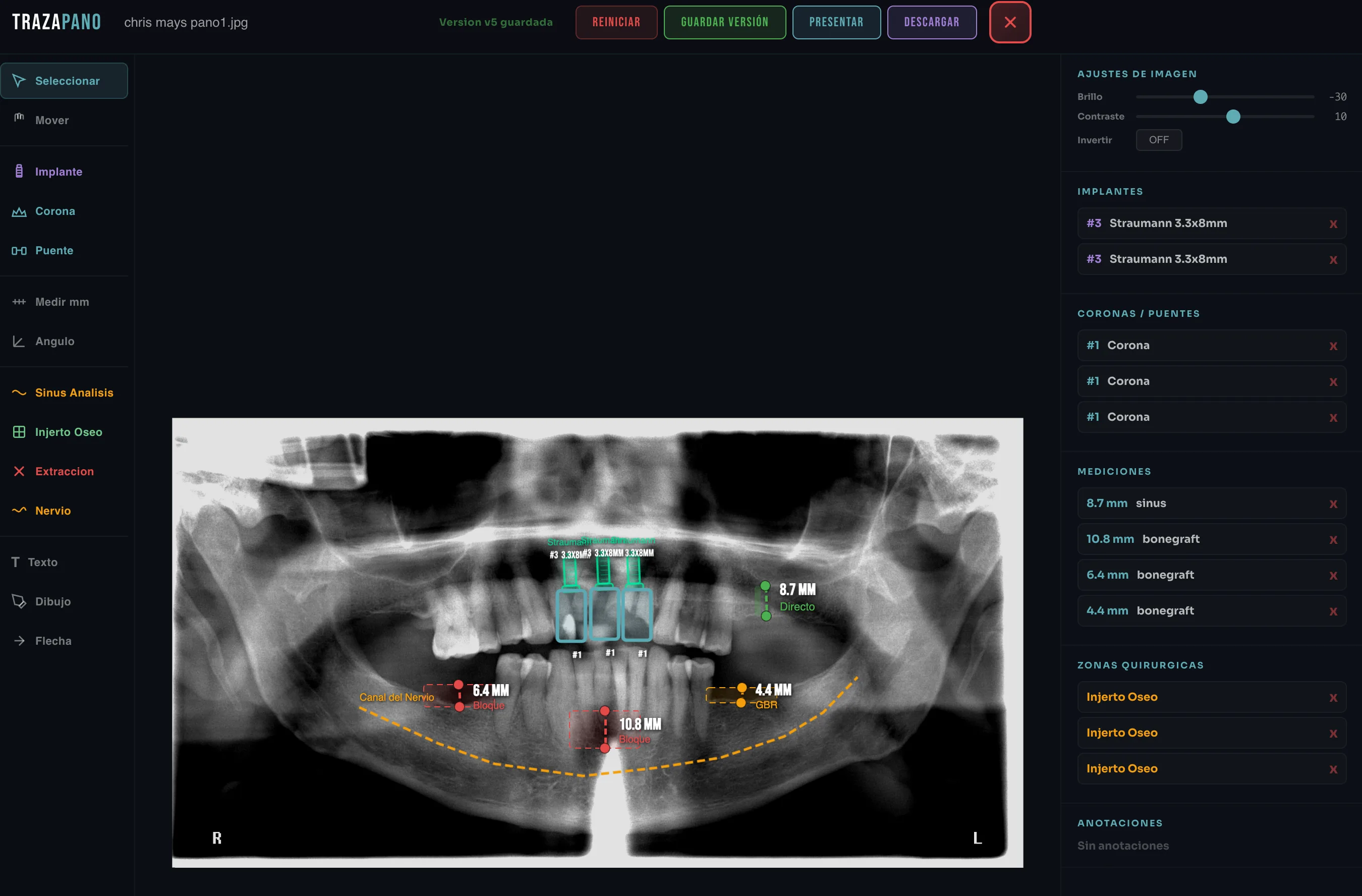
Surgical planning on panoramic X-rays is still analog, imprecise, and disposable.
Surgeons print the panoramic and draw on it with markers. The plan lives on paper that wrinkles, stains, and gets lost.
Without calibration, there is no way to know real bone height or available width. It gets eyeballed, and that creates surprises in surgery.
The lab gets blurry photos of the hand-drawn plan and guesses the surgeon’s intent. Without digital data, communication breaks.
No versioning, no history. If the paper is lost, the plan is lost. Months of surgical analysis vanish in a drawer.
Each pass extracts a layer of clinical information that would take a human 45 minutes to document. AI does it in seconds.
Identifies each tooth with FDI coordinates and relative position on the panoramic.
#18 present, #17 present, #16 missing
#15 present (mesial tilt 8deg)
#14 root remnant
Total: 24 teeth detected
Catalogs teeth, restorations, root morphology, and image quality.
Restorations: 7 (3 amalgam, 4 composite)
Endodontics: #36, #46
Existing implants: #26 (screw visible)
Image quality: 8.2/10
Detects 25+ pathology types: caries, periapical lesions, fractures, resorption.
CARIES: #37 mesial (87% probability)
PERIAPICAL: #46 radiolucency 4mm
RESORPTION: #31 external cervical
FRACTURE: #25 suspicious vertical line
AAP/EFP 2017 classification, Misch D1-D4 density, Klemetti index.
Periodontitis: Stage III Grade B
Bone defect: #36 vertical 6mm
Density zone #16: D3 (trabecular)
Klemetti: C2 (eroded cortical)
Maxillary sinuses, nerve canals, TMJ, third molars (Winter/Pell-Gregory).
R maxillary sinus: pneumatized (floor 3mm from #16)
Inf. alveolar nerve: bilateral trace
#48: Winter mesioangular, Pell-Gregory IIB
TMJ: R condyle asymmetric
Bone estimation, recommended implant size, augmentation needs, success probability.
Zone #16: bone 8mm height, 7mm width
Recommended: 4.1x8mm with sinus lift
Augmentation: lateral graft + membrane
Success probability: 92%
Pick the implant system you use — Straumann, Zimmer, Implant Direct, Nobel, BioHorizons — and place virtual implants with real measurements on the panoramic. See the relationship with nerve and sinus before cutting.
Calibrate the panoramic with a known reference and measure bone heights, ridge widths, and inclination angles with submillimeter precision. Every measurement is saved with the plan.
Select abutments, pontics, single crowns, and extractions directly on the panoramic. The plan uses universal FDI numbering for unambiguous communication with the lab.
Mark existing bone level and the level you need to reach with the graft. TrazaPano calculates the difference and clearly visualizes the augmentation zone needed at each surgical site.
Trace the path of the inferior alveolar nerve directly on the panoramic. See the safety distance between the planned implant apex and the nerve canal to avoid paresthesia.
Presentation Mode to explain the plan to the patient chairside. Surgery Mode to operate with a minimalist interface.
Clean interface with no toolbars. Just the plan and annotations. Perfect for explaining treatment to the patient in fullscreen.
Minimalist interface with high contrast for operating use. Only keyboard shortcuts and essential information visible during the procedure.
Every component is chosen for performance, precision, and reliability in a clinical context.
What changes when your surgical planning goes digital.
Your next panoramic,
planned.
With surgical precision.
14 days free. No credit card. Upload your first panoramic in 2 minutes and see what the AI finds.